
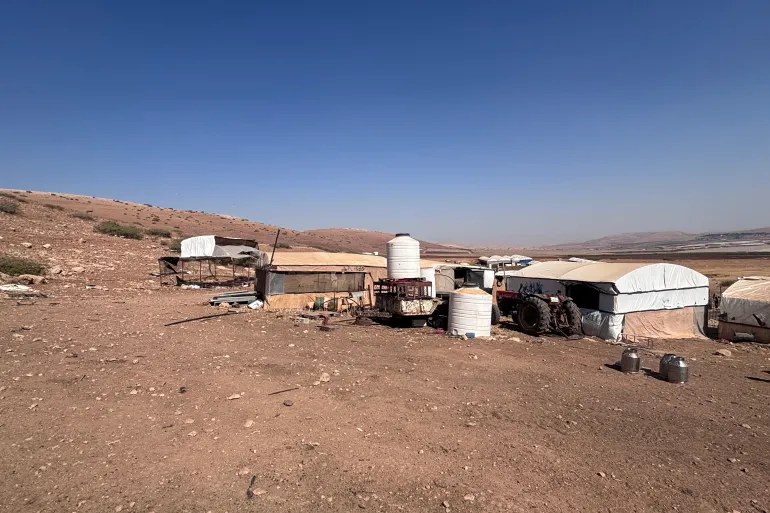
Ras al-Ahmar, occupied West Bank – The drive to Thaer Bisharat’s home should take less than 10 minutes from the main road. Instead, it took three hours.
Every gate leading into Ras al-Ahmar, in the northern Jordan Valley, is shut these days. Such road closures have become the norm rather than the exception, patrolled in shifts by Israeli soldiers and settlers whose roles on the ground have become increasingly difficult to tell apart. The sole access point that remained was a single, winding dirt road, passable only by four-wheel drive vehicles and requiring drivers to evade the roving Israeli patrols.
During the drive to Thaer’s house, Israeli forces had the area under an even greater lockdown than normal as they were nearby in the al-Buqaia plain, destroying three wells belonging to local Palestinians – including one owned by a relative of Thaer’s.
This is some of the most fertile land in the occupied West Bank, where farmers normally tend rows of banana trees alongside crops such as grapes, olives and potatoes. But along the dirt road leading to Thaer’s isolated home, the farms stand half-abandoned, with plastic greenhouse doors open and flapping in the breeze, as crops go thirsty after water was cut off in the area weeks ago by Israeli authorities.
“I can’t even run an errand,” said Thaer. “From Tamun, the village, it used to take me ten minutes. Now, with the current [dirt] road… it takes an hour, at best.”
He was spending the afternoon alone – his brother and sister-in-law had gone into town that morning for basic necessities. Left by himself, it was easy to feel like a sitting duck.